
Stalk Dirty to Me
Notes from inside the sunflower forest

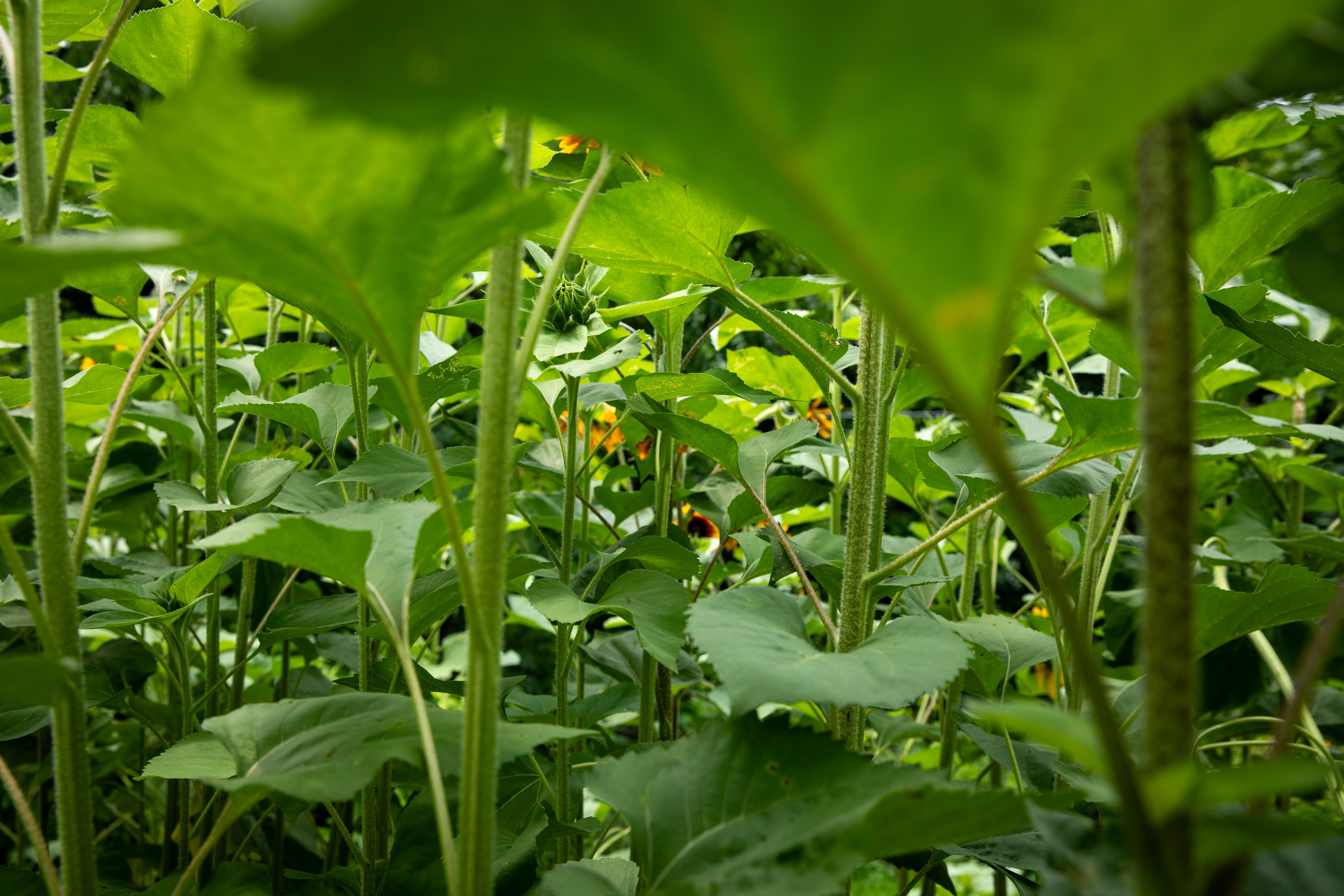
I have to push through it now—that’s what I keep coming back to. There’s a forest of sunflowers in the old compost patch, self-seeded from last summer’s plants, and at some point it stopped being a patch and became architecture. I did not sow them. I did not water them. I did not stake them or thin them or fuss over them. I contributed, spiritually, almost nothing. And yet they have become something you enter—a room with green walls and a yellow ceiling, taller than me in every direction.
The sunflowers are shoulder to shoulder, hip to hip, leaf to leaf—behaving less like plants and more like bouncers. Their stalks are thick and hairy. Their leaves are enormous, scratchy, Jurassic. Bees weave through them deftly. Lady disappears into the lower growth and then erupts out the other side with burrs in her fur and the expression of a dog who has seen things.
I keep telling myself I should thin them. This is what a responsible gardener would do—choose the strongest plants, yank the extras, improve airflow, prevent mildew. Unfortunately, I am not a responsible gardener. I am a woman standing in a volunteer sunflower forest asking no one, “But what if this one has a good personality?”
So instead of thinning, I push through.
There was a path in June, when it was still possible to distinguish between “sunflower” and “not sunflower,” between “garden bed” and “place where my body could theoretically be found.” By July, those categories have dissolved, because July is not a month—July is an uprising. Everything is too tall, too fast, too thirsty. The tomatoes have already outgrown their cages without producing a single ripe fruit. The peas are mostly over, the herbs have bolted, the weeds have achieved sentience, and the sunflowers have declared themselves a sovereign nation.
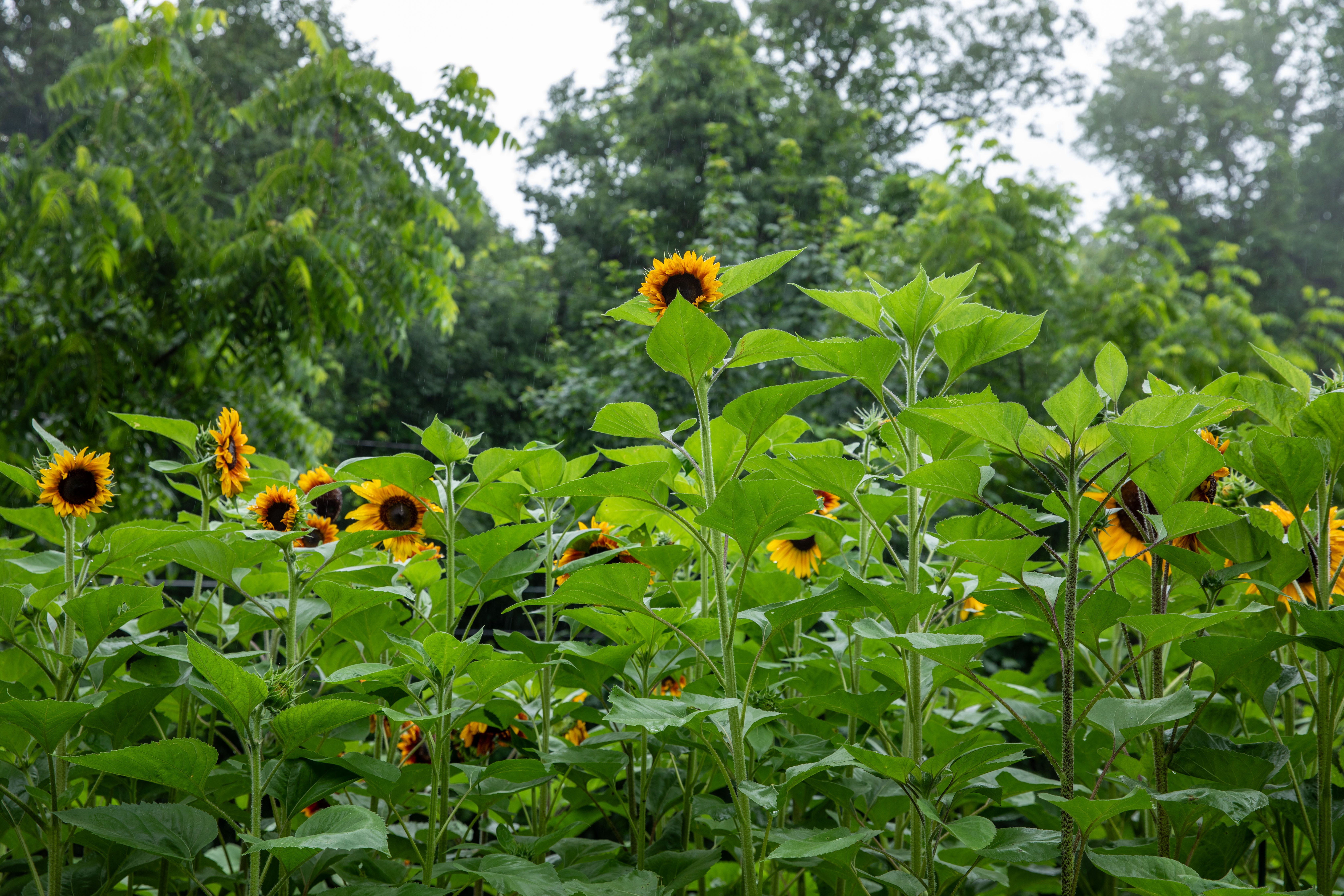
The old compost patch feels like the correct place for this to happen. Compost is already a place where the past becomes unreasonable. Banana peels, coffee grounds, chicken bedding, dead leaves, spent flowers, things cut down because they were finished or ugly or in the way. It is supposed to become soil—quietly, politely, out of sight. You throw things there because you are done with them, then months later they return as nourishment, which sounds beautiful until it happens with squash.
The sunflowers did not volunteer in the sense of being invited. They appeared and took root. They made themselves at home in the place where I once put the dead things. I could have pulled them when they were small, when they were just anonymous green mouths opening in the soil.
Now they are two feet taller than I am. They are also beautiful—annoyingly, stupidly beautiful. Each one lifts its face toward the light as if this was the plan all along—as if I meant to create a sunflower chapel behind the house.
Most evenings, I go out with the hose and do the rounds. I water barefoot while mosquitoes eat the soft parts of my ankles. The raised beds first, then the roses, the pots, the trellis—whatever looks most dramatic. July watering is less a chore than a nightly negotiation with the summer sun. Everything wants something—consistency, forgiveness, for me to understand they are under a lot of pressure right now.
The sunflowers want very little from me. This should comfort me, but it doesn’t. I prefer plants that need me in obvious ways—floppy, wilting things that look better after I intervene. There is a small satisfaction in rescue, in being necessary with a watering can. The sunflowers refuse to give me that. They grew from what was left, they found the light, and they made a forest out of neglect and weather and chance.
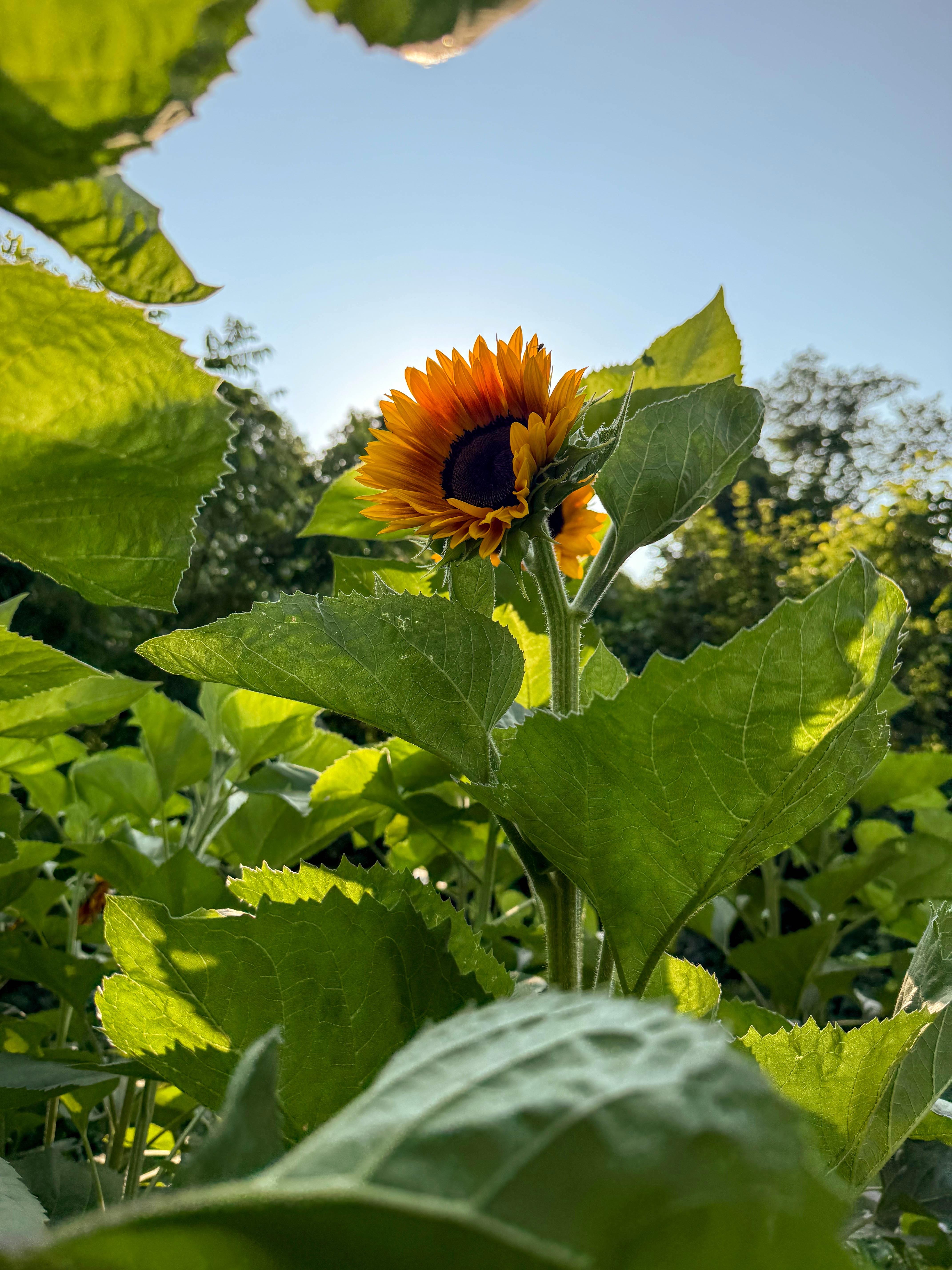
James runs straight into them, the sunflowers close around him, and for a second all I can see is movement—yellow heads, green stalks, one small boy thrashing through leaves. I watch him run with abandon and think about his sister. Daisy would have loved this. She never saw the sunflowers in the old compost patch turn feral and ridiculous. She never saw her little brother run through the yard with a chicken feather in one hand and a magnifying glass in the other, conducting serious business. She never saw the garden become this version of itself, lush and overfull and badly behaved.
The truth is, I hate that things keep growing. I also hate when they don’t. I want the garden to stop and I want it to bloom. I want proof that life continues and I resent every piece of evidence. I want the sunflowers. I want to lie down in the middle of them and be hidden. I want to cut them for a vase. I want to leave every single one standing because who am I, really, to remove anything that came back?
I push through instead—past the stalks, past the bees, past the leaves dragging their rough green hands across my arms. The path is still there, technically, though it no longer belongs to me. The zinnias are somewhere beyond it. The dahlias are at the mercy of their shade. Lady is crashing around beneath the canopy like a bear while James laughs from inside a place I did not plant. The sunflowers keep their faces turned toward the light. I keep walking through them, because there is no way around.
🪱 COMPOST FOR THE SOUL
And did you get what
you wanted from this life, even so?
I did.
And what did you want?
To call myself beloved, to feel myself
beloved on the earth.
—Raymond Carver
🐓 BACKYARD DISPATCH
Fowl Weather
It rained all day, which meant the chickens were busy looking betrayed by water.
For animals descended from dinosaurs, chickens have a surprisingly fragile relationship with drizzle. One drop lands on their back and suddenly they are not mighty descendants of the thunder lizard. They are tiny damp freaks in feather pants. Their feathers separate into strange little points. Their feet get muddy. Their combs go a deeper, more alarmed red. Sometimes they look bald.
Most of them did the sensible bird thing and took shelter. They crammed themselves into the least convenient part of the run and complained via clucks. Not alarm clucks. Not egg song. Just low, muttering, municipal clucks.
Hen Affleck stood beneath the coop, looking wet and weird and wronged. Benechick Cumberbatch kept venturing three steps into the rain, reconsidering her entire life, and returning to shelter as if she’d touched a hot stove. Eggward Norton scratched halfheartedly at the mud, as if hoping to uncover a personality, or at least a worm.
But Emily Chickinson, naturally, had removed herself from the common rabble. I found her in the laying box, tucked into the straw like a tiny feathered widow in a boarding house novel. While the others milled around outside in various stages of despair, Emily had chosen privacy, ambiance, and a dry place to be round.
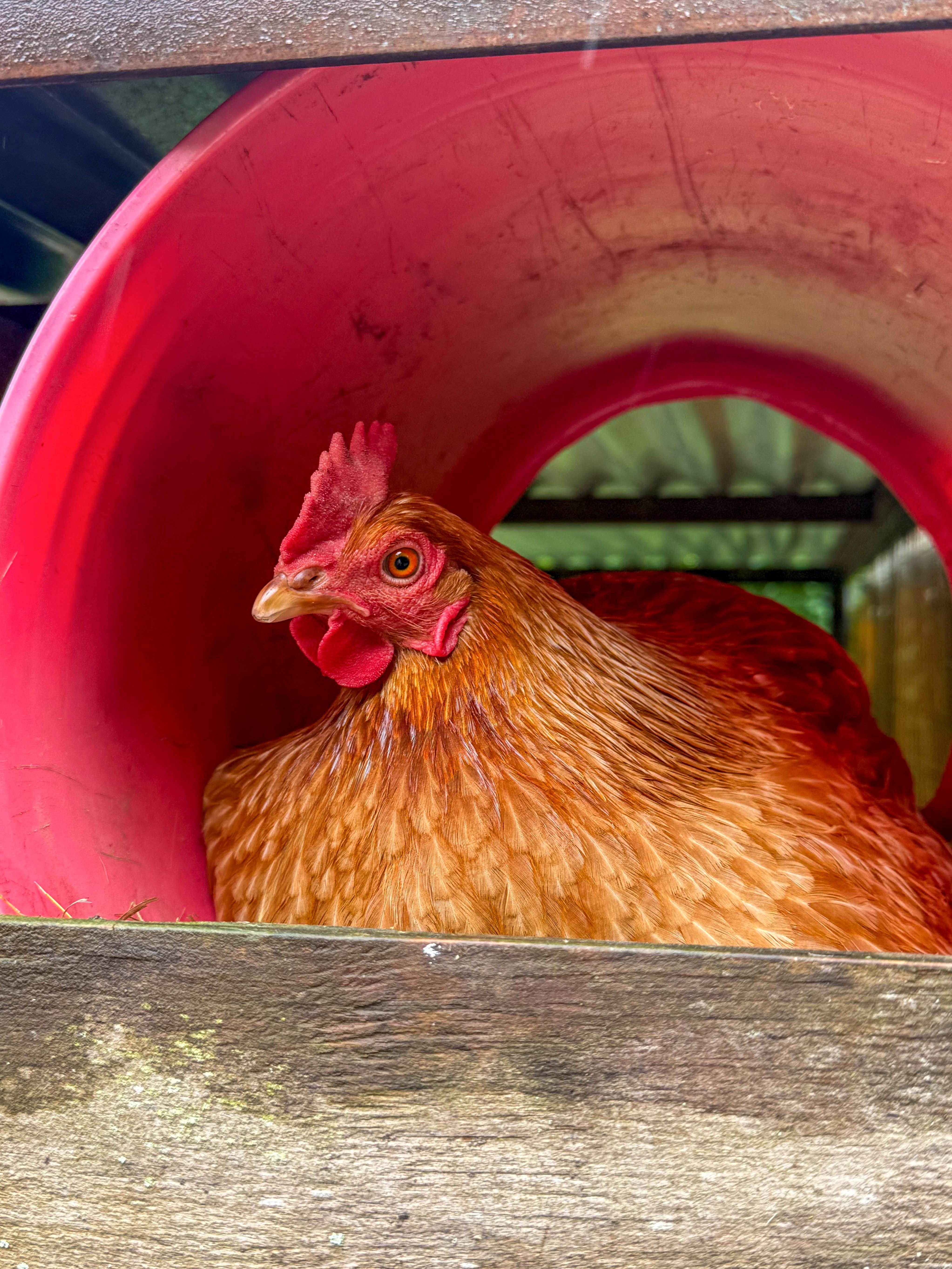
Was she escaping the rain? Possibly. Was she broody? Maybe. Is she simply an amazing little bird with a deep commitment to the narrative? Also yes. But was she also, technically, just laying an egg? I'll put it to you this way: she looked less like a chicken doing chicken business and more like a nineteenth-century spinster taking to bed after receiving troubling correspondence.
Meanwhile, Feather Locklear has entered a new and unsettling phase of our relationship: avoidance. He sees me and goes elsewhere, which is to say not directly at my shins. No charge. No murder-foot. Just a brisk little pivot in the other direction, as if I’m an ex he spotted in the cereal aisle.
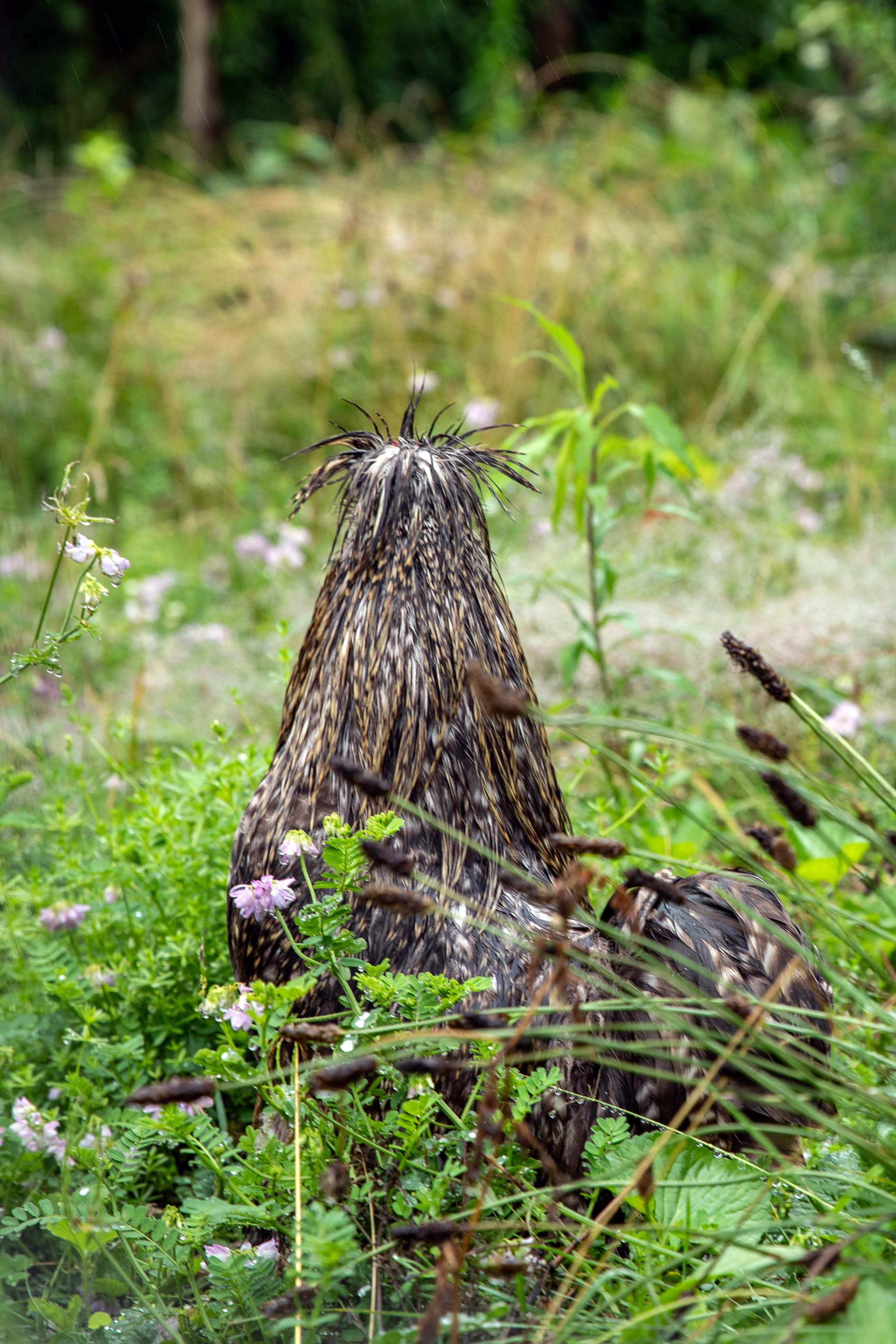
He spent much of the afternoon standing apart from the flock, wet tail feathers drooping, chest puffed, one small orange eye locked onto the abyss. Every so often he tore his eye away from whatever dark arithmetic roosters do in the rain to give me a restrained look, and maintained a distance that appeared court-ordered.
I guess I’ll take it.
It was a peaceful, deeply concerning rainy day in the chicken run. No one attacked me. Everyone looked terrible.
🌹 BLOOM REPORT
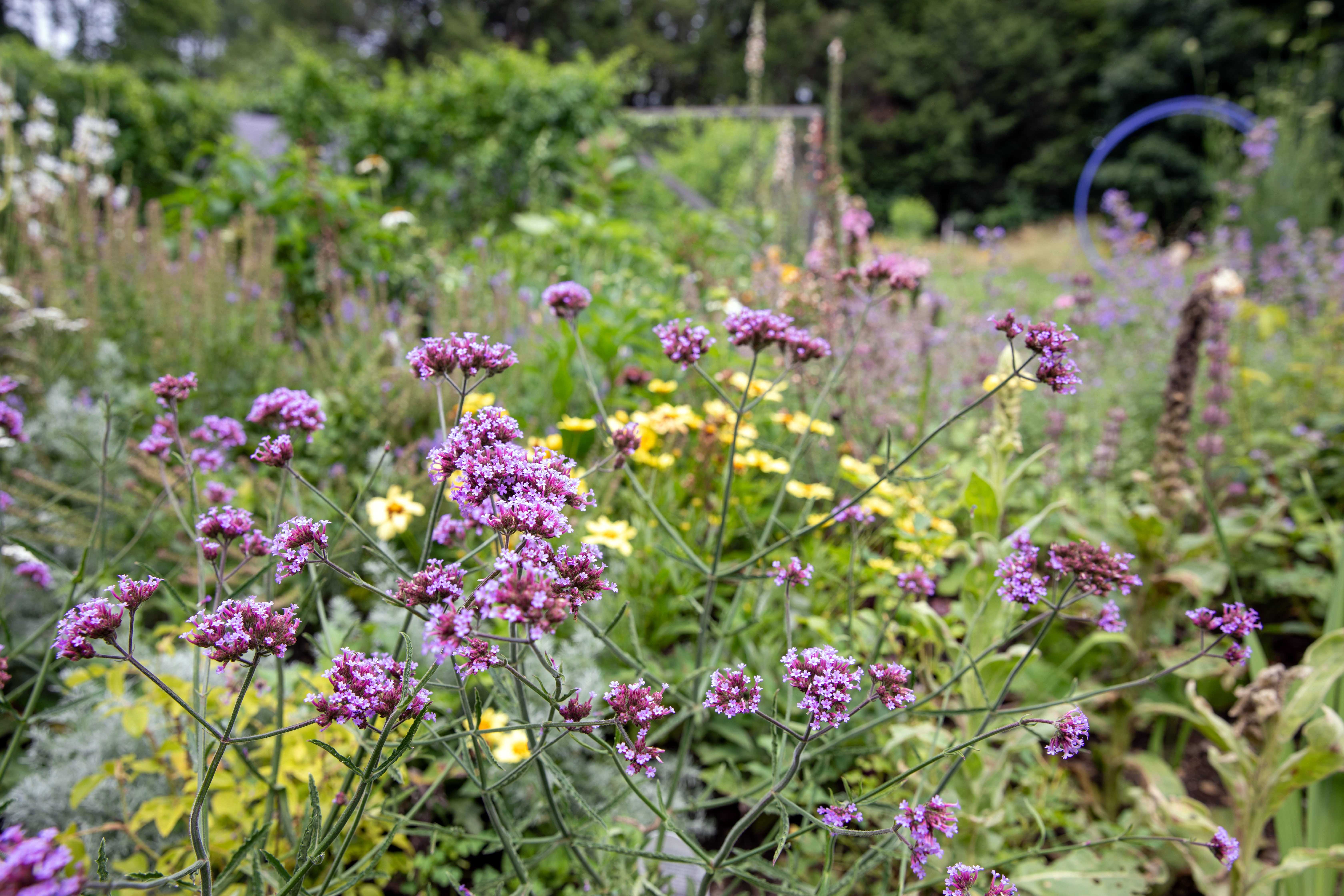
Verbena bonariensis — Technically a weed with excellent publicity. Tall, wiry, and nearly invisible at the base, so the purple flower clusters hover mid-air over everything else, like the garden is thinking in punctuation.
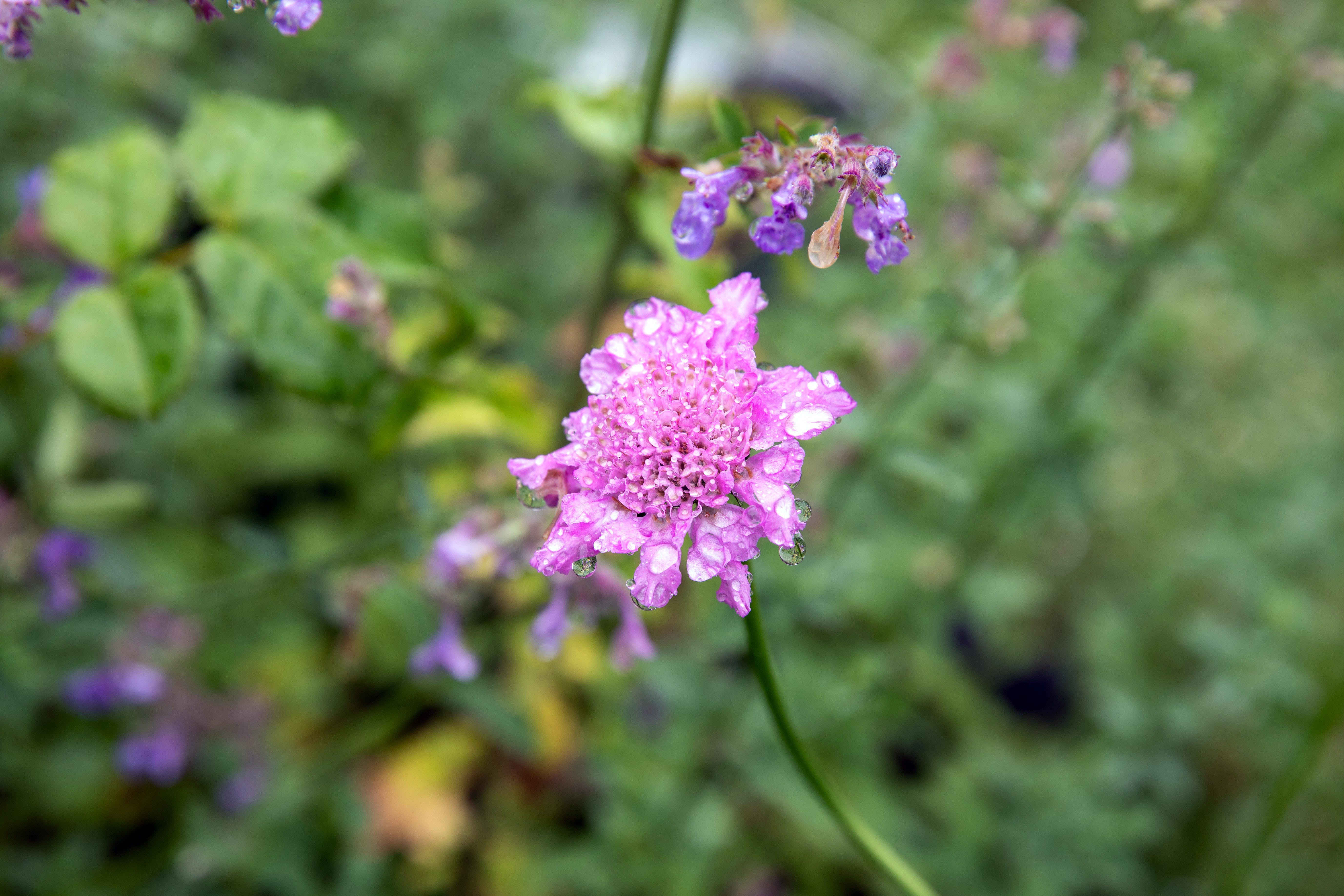
Scabiosa — The most photogenic thing in the entire bed today, purely on a technicality: rain. Every petal is holding its own private water droplet.
🥔 PICK ME DIRTY
The Curious Incident of the Potato in the Dirt
You’ll recall from last week the tiny potato I dug up early, panicked over, washed, and reburied. Anyway, after that I did what any normal person would do: I went back looking for its siblings.
In my defense, Monty Don, patron saint of calm interference and extremely gentle trespassing, says first potatoes can be lifted in July. Also, I planted these in April, which I had forgotten because April was fourteen years ago and I was a different woman with no known potato priors.
So I reached into the soil again, this time with the confidence of someone retroactively calling a crime “harvest.”
And there they were. Not one potato. Not a rumor of potato.
Potatoes.
Pink. Dirty. Real. More than one.
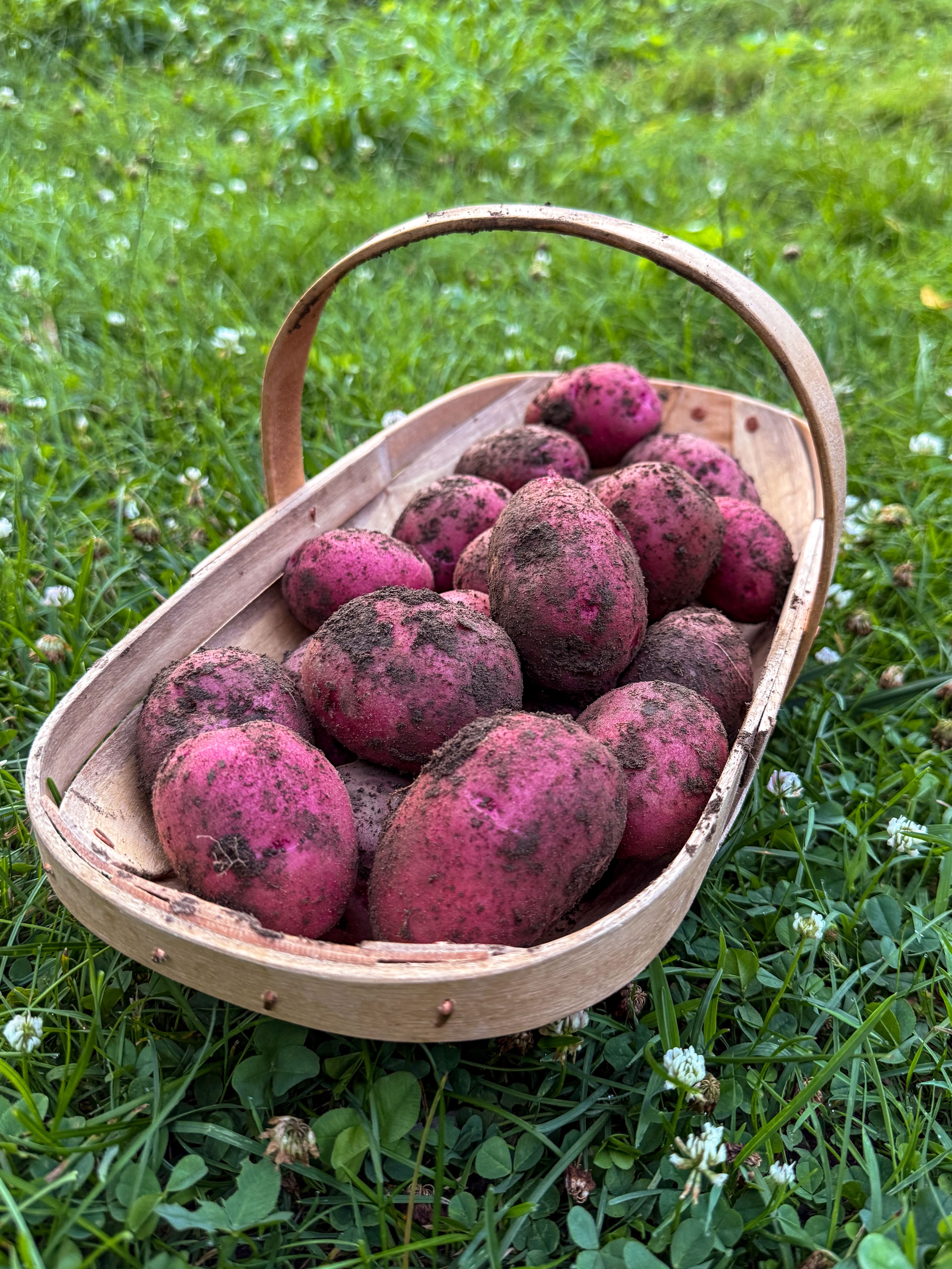
Sometimes you do the weird thing, the fake thing, the “bury seed potato chunks under dirt and trust the darkness” thing, and months later the ground hands you dinner.
Naturally, I conducted a one-potato clinical trial by boiling exactly one potato. I smothered it in butter and salt, ate it standing up, and declared the harvest a success with all the scientific rigor of a woman eating one potato over the sink.
Of course it was delicious. Butter and salt have been laundering reputations for centuries.
In the end, I dug up a few. I left most for later. I tried not to make it weird.
It was already weird.
🌾 FIELD REPORT
Crouching Rooster, Hidden Agenda
Hypothesis
Rooster subject has either undergone genuine moral growth or is engaged in long-con reconnaissance. Current avoidance behavior may indicate de-escalation, maturity, strategic repositioning, or a more sophisticated attack model.
Field Notes From the Yard
For approximately six months, Feather Locklear has maintained a well-documented hostile relationship with my shins. Previous incidents involved charging, wing-flapping, sudden directional changes, and the weaponized use of what researchers have come to classify as murder-foot.
Recent observations, however, suggest a dramatic behavioral shift. Since last Friday, subject has not attacked researcher once. More concerningly, subject appears to be avoiding researcher. Subject now alters course on sighting the researcher, executing what witnesses describe as "a brisk little pivot," and busies himself elsewhere.
Methodology
Enter the run holding a rake, not as a weapon, purely for optics
Wear the boots from the solstice incident, for consistency of testing conditions
Make idle small talk with the hens as cover for reconnaissance
Avoid direct eye contact except to establish who looks away first
Document distance maintained by subject in “shins” (unit of measurement, approximate)
Bring backup witness (Lady); receive no usable testimony
Resist urge to say “that’s right, keep walking”
Exit before subject can revise his position
Threat Assessment Timeline
Pre-Friday
Subject frequently engaged in direct shin-based intimidation. Researcher developed heightened awareness of rooster location at all times.
Friday
Last known incident of aggression. Details remain classified due to emotional fatigue.
Saturday–Present
No attacks. No charges. Subject maintains visible distance and appears to redirect his energy toward staring at grass.
Findings
Threat Assessment
Reclassifying subject from ACTIVE HOSTILE to STATUS UNCLEAR (CHICKEN). No white flag, feathered or otherwise, has been observed.
Rooster Ghosting (Ghroosting)
Elevated. Subject now sees researcher and suddenly becomes interested in the wind. Researcher reports complicated feelings about being ignored by someone who once considered her shins worth crossing a yard for.
Moral Development
Inconclusive. No evidence confirms genuine reform. Subject has not apologized, offered restitution, or participated in restorative justice.
Observed Effects on Researcher
inflated self-regard re: personal growth, credited entirely to a chicken
hypervigilance disguised as “checking on the ladies”
repeated attempts to look casual while actively monitoring a bird
mild insult at no longer being considered worth charging
occasional impulse to say, “We good?” to a bird
private suspicion that I am, in fact, the one being rehabilitated
Researcher (me) reported feeling generally unhinged. Available data suggests this is baseline and not rooster-specific.
Case Study
At approximately 3:41 p.m., researcher enters the run to check the waterer. Subject, positioned near the far fence line, turns to assess the situation. A pause follows—three full seconds. Subject does not charge. Subject does not flee. Subject simply turns, unhurried, and walks in the opposite direction with the specific gait of someone obeying a private bell.
Researcher exits the run unscathed.
Researcher does not feel unscathed.
Conclusion
Feather Locklear’s motives remain officially unknown. Working theories include spiritual reform, reduced shin interest, private rooster reasons, or the devastating possibility that the researcher is no longer worth pursuing—which, if true, may be the most insulting possible explanation, and also the most likely one.
Further observation is recommended. Protective footwear remains advisable.
🐝 BEE STILL MY HEART
The Buzz Is Coming from Inside the Forest
The sunflower forest, it turns out, has excellent word-of-mouth. Bees are everywhere in it—mostly bumblebees, a few honeybees, and a scattering of smaller, stripier freelancers I will never accurately identify without becoming a different person entirely.
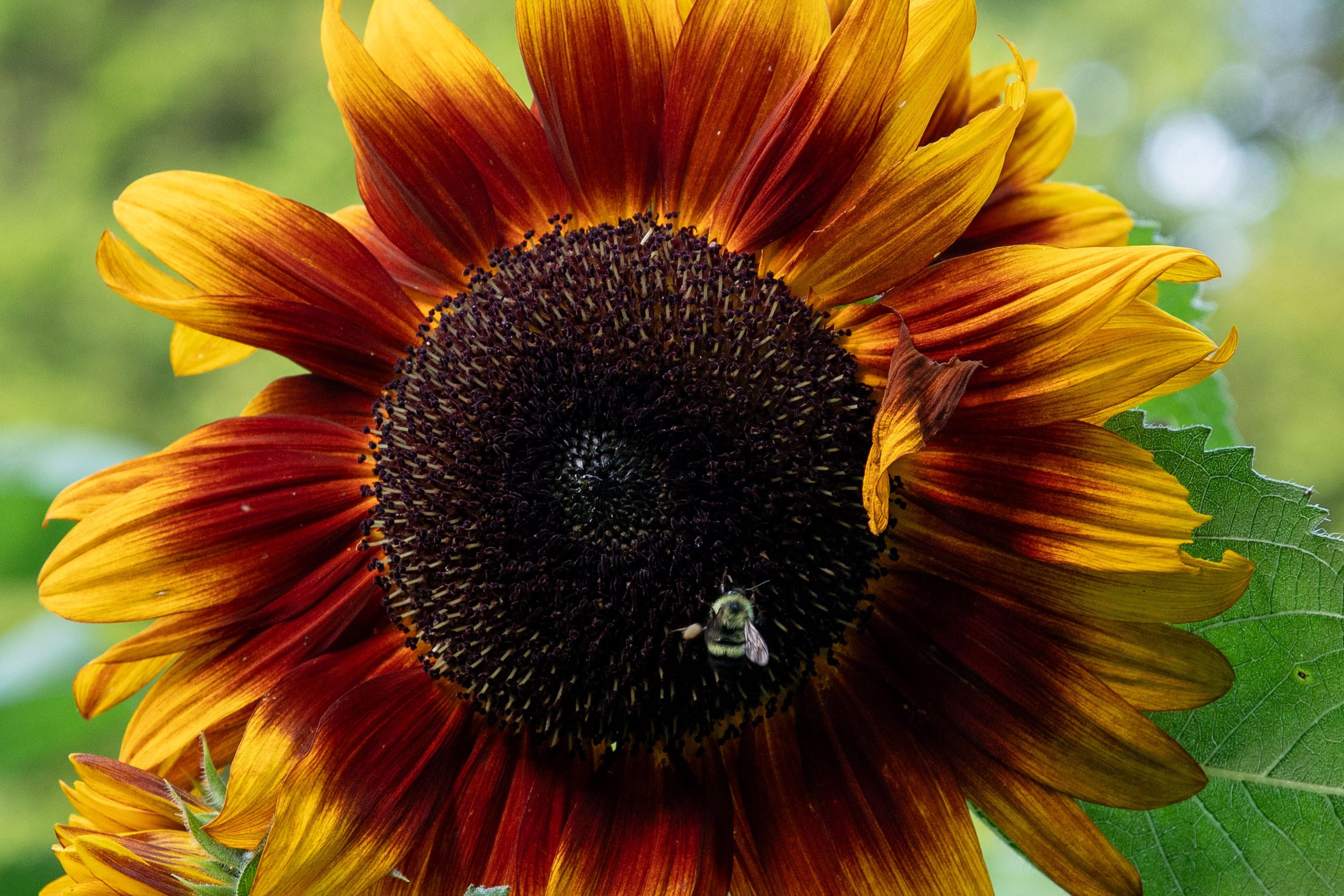
I used to take bees for granted—as ambient garden noise, a given, weather. I don’t anymore. So when a bee shows up now, it doesn’t register as scenery. It registers as a small, unpaid kindness. Nobody sent her. She just arrived, doing the ordinary work of being alive in my yard.
The sunflower fed her. I took it as a compliment.
Mostly, watching a bumblebee stagger out of a sunflower dusted head to fuzzy toe in gold, I feel joy—the specific, uncomplicated kind. She looks like she lost a fight with a powdered donut and considers it a win. I don’t need the ecology lecture to love her. I already do.
🎧 BEET DROPS
Talking Heads — “[Nothing But] Flowers”
For the places that grow back stranger, wilder, and more beautiful than planned.
Potatoes! Chickens! Meditations on waking up every morning and choosing flowers!
💙💙💙
Potatoes look great