
Withering Heights
Where beauty lingers after bloom.

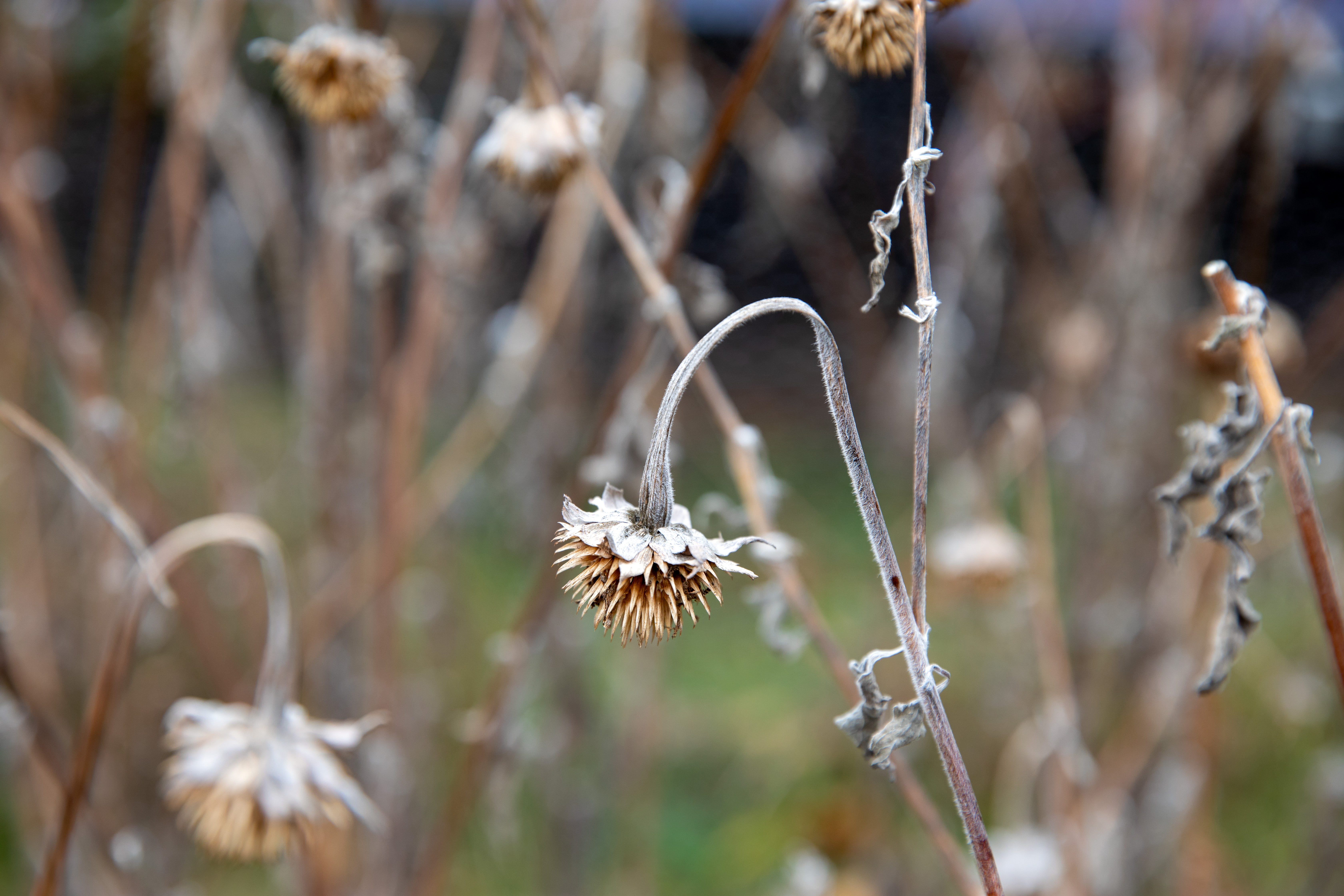
By November, the garden is a soft heap of itself—aren’t we all? When I brush against the plants, they yield with the honesty of something decidedly finished. Color is now bruised and secretive, tucked into the folds of decay. A few random survivors persist: the single cornflower, a couple of violets, the scabiosa. But the show is over, the striving done.
Wilt isn’t death—it’s the body remembering gravity. The garden isn’t asking to be rescued or revived; it’s letting stillness have the last word. Just before dawn on a frosty morning, I linger among the ruins, eyes bleary, hands empty, breath visible. The maple leaves cling to the driveway in wet clusters. Rain and wood smoke mingle in the air, and the earth smells of rot and rest. I hold a brittle zinnia stem in my hand. It breaks without resistance, and I’m struck by its delicacy, by how thoroughly it gave itself to the season. It has nothing left to prove. (I’m still learning that one.)
We celebrate beginnings—the tight bud, the unfurling, the neat story of potential. Decline doesn’t get the same press. It’s hidden, pruned, composted, deleted. But if you let yourself see it, the garden grows extravagant in its undoing. Petals spot and fade like old silk. Seedheads swell and harden, bending their stems into curious shapes. Color shifts slowly: violet to rust, gold to umber. The whole scene loses its gloss and gains character.
Somewhere between rot and relic is where beauty gets interesting. The Japanese call it wabi-sabi—the grace of imperfection, the poetry of transience. The Dutch masters painted it in their vanitas still lifes—skulls, roses gone soft, fruit just beginning to turn—as a reminder that beauty and abundance are fleeting, that pleasure ripens toward loss.

The idea is that true beauty isn’t in the pristine or the ruined—it’s in the in-between, where something is still giving itself over to time. It’s the moment when what’s fading holds more truth than what’s fresh. You don’t need to be Rembrandt to find it; it’s in the lived-in—the undone hair, the wrinkled linen, the chipped mug, the dog hair on the couch, the ashes in the fireplace.
It takes restraint to resist “fresh.” The urge to fix or tidy runs so deep we have to practice not practicing. We live in a culture allergic to droop. We perk, brighten, lift, tone, filter, swipe, refresh, repeat. Even our flowers come with promises of “longer vase life,” as if beauty were measured in shelf stability. But wilt has dignity too. It says, I’ve done my part. There’s a kind of generosity in turning one thing into another.
I used to see composting purely as a form of disposal. Now I know it’s resurrection by other means. Yesterday’s blossoms become tomorrow’s soil—color rendered to humus, glamour to grit. There’s no tragedy in it, just chemistry. That’s the garden’s truth: nothing really leaves. Every stalk, every petal, every fallen leaf keeps working, quietly, out of sight. Everything is content in its cycle, and unconcerned with what it used to be. It’s to trust that fading has purpose.
The garden isn’t clinging to its summer self—it’s busy becoming something else. Lines deepen, colors dull, edges fray. I let the blackened zinnias lean on their neighbors, the coneflowers keep their seed heads for the finches, the vines collapse into their own soft architecture. They all whisper the same thing: impermanence has better texture.
I think about this when I see my own reflection. The freckles that used to fade now stay. The skin softens where it once held firm. My hands look more creased, calloused, and veined. My instinct is to feel it all as loss, but really it’s evidence of life. And isn’t that the point—to be changed by time?
Turns out you can learn a lot from the art of drooping: that softness is a kind of strength, that surrender can be stunning, and that nothing thrives forever. It’s the willingness to meet life without the armor of fresh paint. There’s also relief in being finished. The garden no longer performs; it just exists. It’s easy to mistake that for emptiness, but really it’s abundance turned inward. Everything that once demanded attention now gives itself away.

When I walk through the garden in November, I don’t feel sorry for what’s gone. I feel grateful for the trade: brightness for depth, color for texture, noise for silence. I stand at the edge of it and watch the light change—the way the golden hour gilds the ruins, even if just for a moment. The world narrows and somehow expands.
Maybe the art of wilt is learning to love things when they stop trying so hard. It’s standing still long enough to see what beauty becomes when it no longer needs to bloom—not a tragedy, but a generosity. The final gift before stillness.
🪱 COMPOST FOR THE SOUL
Men must endure
Their going hence, even as their coming hither:
Ripeness is all.
—King Lear, Act V, Scene 2
🐓 BACKYARD DISPATCH
The Henlightenment
There’s a spot by the southwest corner of the run where the hens have hollowed out a shallow pit—a sunken temple, really. Every afternoon they gather there as if summoned by forces older than time, and commence the ritual: flop, roll, flutter, transcend. They writhe in slow motion, tossing dust through their feathers. If you’ve ever wondered what spa day on MDMA looks like for a creature with a brain the size of a walnut, it’s this.

Science blandly calls it “dust bathing,” a way to clean feathers and deter mites.
Please.
What happens in that pit is no mere hygiene. It’s ecstatic ceremony.
The first to enter is usually Yolko Ono, eyes bright but also kind of dead. She lowers herself into the dirt like a wobbly high priestess, wings half-spread, and clucks to herself. The other gals—Hen Affleck, Benechick Cumberbatch, Eggward Norton—join one by one, forming a feathery constellation. They shimmy and particles rise. Their eyes go half-lidded; Eggward seems to enter a fugue state. Benechick opens her beak and lets out a guttural croon, somewhere between Tibetan throat singing and malfunctioning Roomba. They toss dust until it coats everything—wings, combs, the edges of reality.
Feather Locklear, tragically not a hen, keeps his distance. He watches from the edge of the run, feathers slicked like he’s above it all—or maybe afraid of what he might see. Transcendence, it seems, is not for everyone.
And then come the prophecies.
Yolko clucks, eyes rolled back. I lean in, clutching the compost pail.
“A hawk shall circle thrice, but not descend.”
“The hand that scatters niblets shall drop her phone yet again.”
“There is no worm, only the idea of worm.”
The others cluck their approval, though it’s unclear whether they’re moved or just itchy. It’s also unclear whether chickens communicate via cluck.

Sure—science insists this is about feather maintenance, but we know better. They’re maintaining something for sure—their communion with something dark, deep, and unknowable. There’s something unholy about a creature that cleanses itself by rolling in filth.
When they’re done, they rise like demigoddesses from the ash, shake off the dust of revelation, and return to pecking as if nothing happened. I dump out the kitchen scraps, turn and head back to the house, pretending I wasn’t moved to tears.
🧣 THE OVERWINTERING
The Need for Seed
Before the freeze sets in, I gather a few things for next year: not intentions, not sage for smudging—just seeds. Once the plants are dry and crisp, I move through the garden with a paper bag and a vague sense of thriftiness and entitlement.
I grew over ten varieties of sunflower this year, all of which thrived. I waited until the backs of the heads turned from green to papery brown and the seeds felt firm to the touch. I cut them before they dried completely on the stalk—since I was up against the neighborhood birds—and hung them in my “gardening shed” (my side of the garage).


Later, I rubbed the heads over a sheet pan, let the seeds fall like confetti, and left them to dry a few days more before storing. My preferred method of storage is to stuff them into cute lil envelopes labeled with something slightly deranged like “I am great at saving money! (Love-in-a-Mist ‘Miss Jekyll’),” or “love2hoe@aol.com (‘Valkyrie’ Zinnias),” or “My life is chaos! (Sunflower mix),” and keep them in a shoebox in the basement. Cool, dark, and dry is the name of the game—just like last week's post on corms and tubers.
Yes, you can buy new seed packets next spring—but where’s the romance in that? It’s also an act of preserving your favorite varieties, especially those that thrived in your soil and microclimate.
And then there’s the sentimental layer: each seed carries a little time capsule of the season you just lived through. Every saved seed is a small act of hope, disguised as housekeeping.
🏺 VASED AND CONFUSED
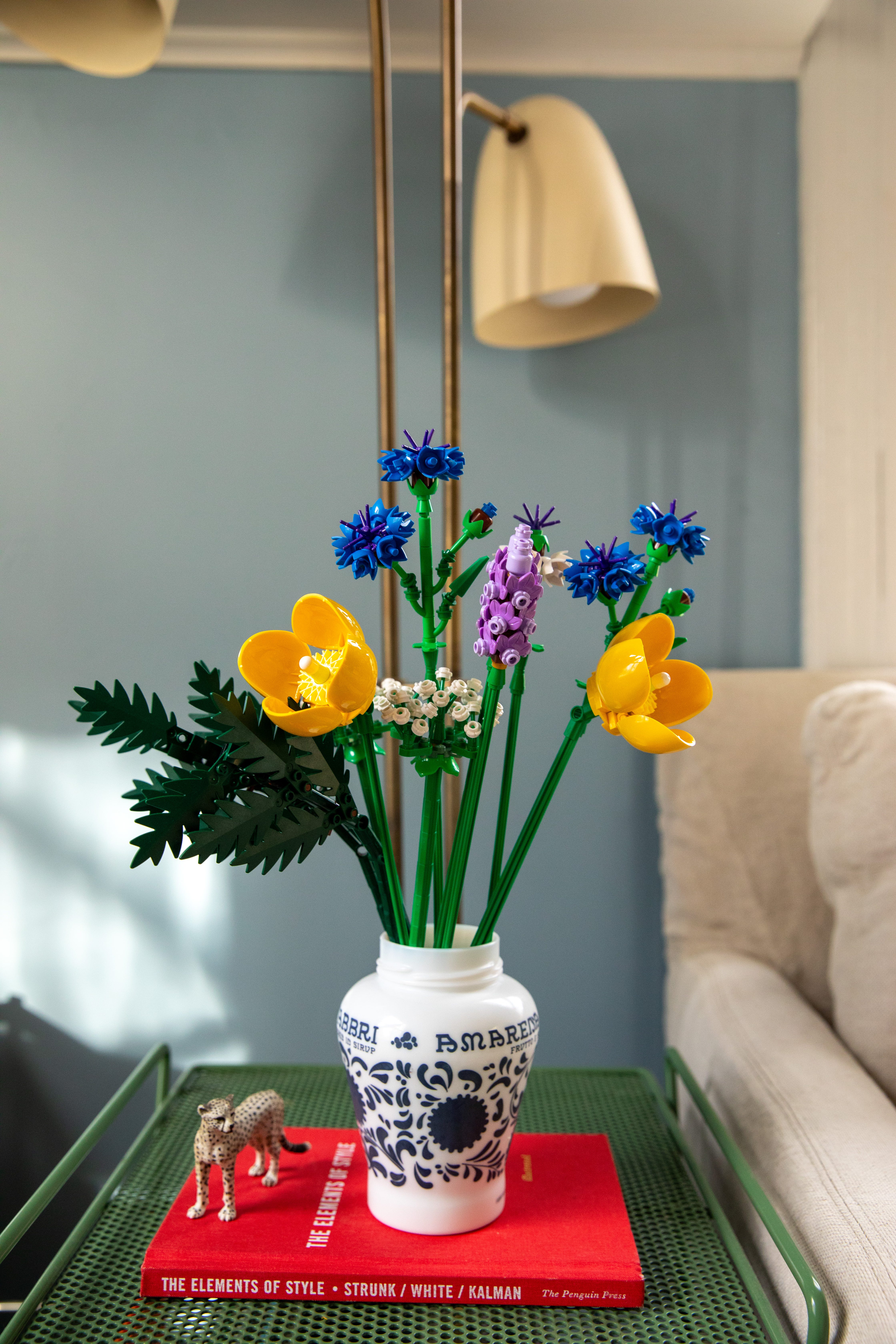
Last weekend at Legoland, between the overpriced food and the sensory assault of primary colors, I bought myself a Lego flower set—because apparently even my hobbies need hobbies. Back home, I dug in eagerly, preparing for delicate, meditative work, fully determined to complete the bouquet. Reader, I made it halfway—and promptly resolved to avoid small plastic pieces for the rest of the year. The rest sits in a Ziploc bag, waiting for another burst of motivation, divine intervention, or 2026. The half-finished bouquet now lives on the side table, a testament to my dirtbag ethos: good intentions, partial follow-through, excellent lighting.
To be continued, probably.
🎧 BEET DROPS
If you’d like to linger a little longer—Joni knows. A soundtrack for the withering heights of November.
(Also, it’s almost Love Actually season.)
love this. you need to read Raising Hare
gorgeous, bex: abundance turned inward. & yeah, for me, love actually is always where the season starts🌲