
#40
No banner, just dirt

Dirty Nails began like my garden: with an inflated sense of control and a wildly inaccurate map of what would grow.
It began because I had too many feelings and a seed drawer that was starting to look like a psychological condition. I thought it would be tidy. Themed. Contained to flowers and vegetables and the occasional chicken scandal. A place to put my seasonal observations so they didn’t rattle around in my chest all winter. A record of what the calendar does to a person who installs basement suns in February and calls it optimism.
I told myself it would be a gardening newsletter. Somewhere along the way, it stopped being decorative and started carrying me. It became a root system. A field report from inside a body that gardens.
In the beginning, I wrote like someone asking permission. I over-explained the jokes. I softened everything in case someone thought: who does she think she is. No one said that—which is how I eventually realized the policing voice was entirely in-house.
There was one message, though. Just a quiet note from someone I have never met that said, essentially: I’ve felt that too—the way hope can look slightly unhinged from the outside.
There is something strange about writing into the dark and realizing it lands somewhere you can’t see. It wasn’t praise—it was recognition. It made me less interested in sounding coherent and more interested in telling the truth.
Still, the bigger shift was repetition. Week after week of showing up to the same patch of earth and the same blank page—and somewhere inside that rhythm, I stopped narrating my right to be here. I let sentences end without apology. I let Daisy enter the room without bubble wrap. I stopped cushioning the grief. I stopped trying to make any of it easier to look at.
I got stranger. More precise.
Writing this every week has changed my eyesight. Dirty Nails has trained me to look longer and to leave things unsmoothed. It has become a way of living with the fact that time keeps moving and so must I. Attention, it turns out, is its own form of survival.
I write about plants growing and dying, and eventually I run out of ways to pretend that’s all I’m writing about. I avoid Disney movies. I avoid the children’s book aisle. I cry in the Guido’s parking lot and then go buy anchovies anyway. Winter feels like a dare. Sometimes I write a sentence for one person and publish it for everyone. I order a bluebird box with a solar-powered wildlife camera for the middle of a field and stop asking whether that’s hope or mild instability.
It has made me braver, but not louder. Brave enough to let a feeling stand without apologizing for it. Trusting a sentence to land without turning it into a lesson. Writing something and leaving it there, knowing someone will understand more than I said.
Every week I still catch myself wondering whether I’m telling the truth or staging something that photographs well—whether I’m planting something that can grow, or just arranging it for light. The answer changes. I still show up and plant anyway.
A weekly practice doesn’t care if you’re in the mood. It doesn’t care if the ground is frozen. You show up, you look, you report. Sometimes that’s lyrical. Sometimes that’s painful. Sometimes it’s personifying alliums in an unromantic 50-cell tray while my nervous system tries to regulate itself in the basement.
I don’t want this space to become slick or optimized until it loses its pulse. I don’t want to start writing toward engagement instead of toward accuracy—even though I still check the stats. I want it to stay muddy. Specific. Slightly unhinged. Rooted in the actual weather of this yard and this body. A place where I can say: this is what it feels like to keep building something that assumes continuity even when continuity has been personally unreliable.
Forty issues in, I am still out here. The yard is still under snow. The boots by the door are not decorative.
Maybe forty doesn’t mean anything. It just felt like a good place to stop and look at what I’ve built before I keep going.
And if you’ve been standing out here with me, in the cold or the mud or the heat of high summer, I’m glad you’re here. Not as subscribers—but as witnesses.
See you next week.
🪱 COMPOST FOR THE SOUL
There is only the fight to recover what has been lost
And found and lost again and again: and now, under conditions
That seem unpropitious. But perhaps neither gain nor loss.
For us, there is only the trying. The rest is not our business.
—T.S. Eliot
🐓 BACKYARD DISPATCH
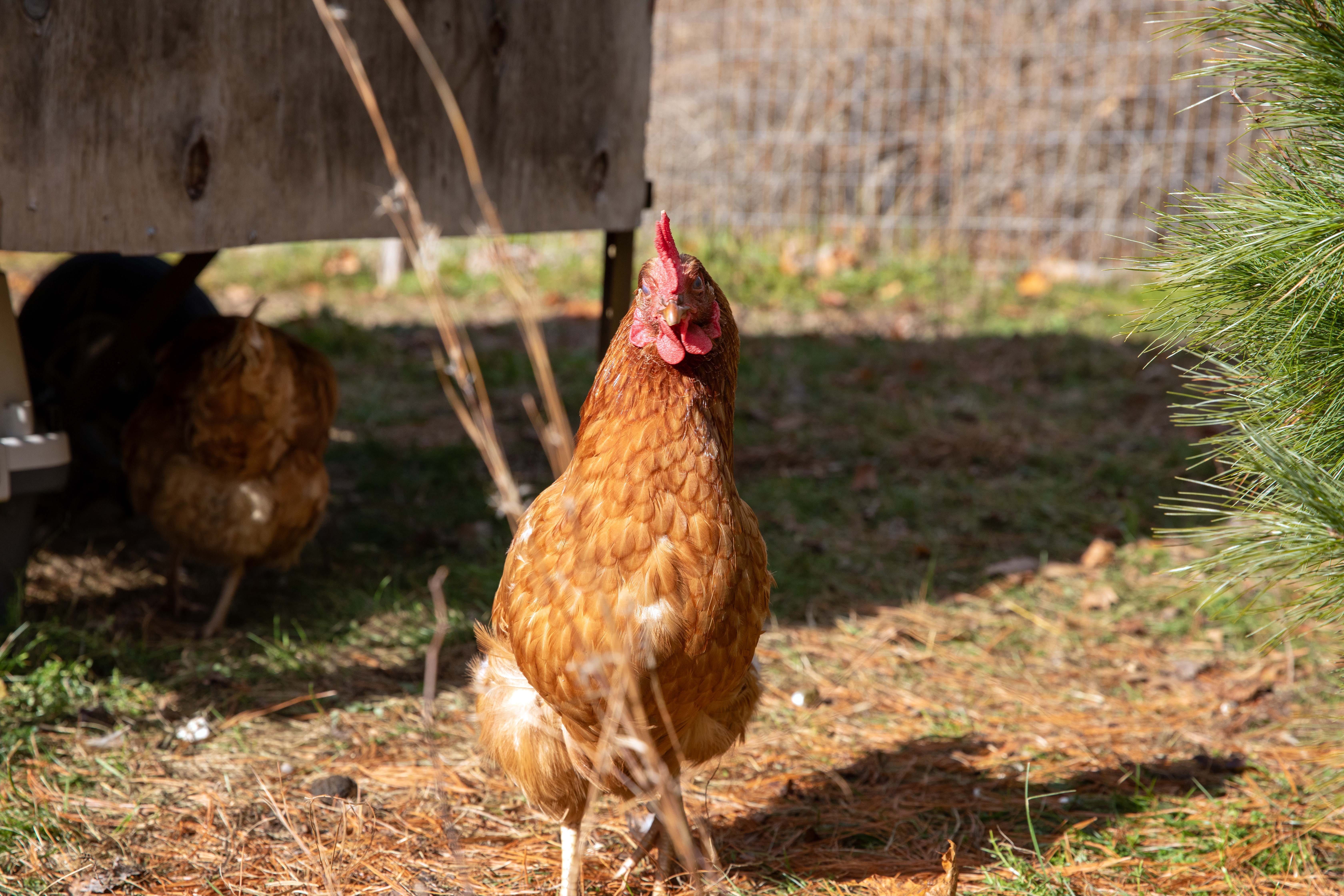
Eggsposé: HEN AFFLECK
Hen Affleck’s origin story begins as many rural political dramas do: with a string of unexplained disappearances.
Before the current administration, there were the guineas. If you’ve never encountered guinea hens, imagine a group of small, anxious Victorian women who have just spotted a ghost and decide to alert the entire parish via fog horn. Their energy was less “backyard poultry” and more “emergency town meeting.”
Very quickly there were not three.
There were two.
Then there was one.

Her name was Fi, and she carried on alone in the yard. We felt bad for her. A single guinea screaming to herself did not feel like the thriving poultry democracy we had envisioned. So we drove to a friend’s poultry farm in New York and returned with two chickens: Hen Affleck and Chickolas Cage, names that implied a kind of gravitas the situation absolutely did not have.

This marked the beginning of what historians will likely call The Great Transition.
Fi died mysteriously while I was at Kripalu doing yoga teacher training—achieving her final form during a unit on ahimsa, the principle of non-violence, which I choose not to examine too closely. Chickolas Cage held on until early July, at which point she vanished overnight in what we believe was a fox-related development.1
The following day, goth silkie rooster Feather Locklear arrived. Since then, the power structure of the yard has been perfectly clear to anyone paying attention.
Feather acts like the leader. He patrols the perimeter. He announces the sun. He announces leaves. He announces the absence of leaves. If a shadow moves funny, Feather holds an urgent press conference.
Hen Affleck, meanwhile, governs. She does not patrol. She does not shout. She does not engage in the sort of theatrical displays that make weaker birds feel important.
When the others panic about a piece of penne, Hen waits.
When Feather delivers a passionate speech about a pinecone, Hen grants him the floor.
When scraps are thrown into the yard, Hen arrives exactly when she intends to and takes the best piece.
Power, Hen has discovered, isn’t the bird making the most noise. It’s the bird who has watched multiple colleagues disappear into the woods and concluded that shouting is not a serious governing strategy.
Physically, Hen is handsome in the slightly rumpled way of someone who has survived several chaotic production cycles. Her feathers fall in layered browns the color of wet cardboard, expensive loafers, and mildly disappointing tea.
Hen lays medium brown eggs: sturdy, symmetrical, vaguely bureaucratic. They feel less like performance and more like paperwork filed in time.
As for her Myers-Briggs, Hen Affleck is unmistakably INTJ:
I – Frequently walks away mid-conversation to stare at the woods and think about things.
N – Understands that the fox is part of a larger network—a “food chain,” if you will.
T – Allows the flock to panic about a grape before calmly taking the grape.
J – Already knows where the niblet will land and has adjusted accordingly.
And if the woods come for another comrade? Hen Affleck will be where she always is the next morning: calmly eating a rotting tomato and continuing the administration, already knowing it was the fox.
🌱 SOW WHAT NOW?
Jug Life
At some point in late winter, a gardener begins making decisions that would appear peculiar to outside observers. For example: cutting open milk jugs, filling them with dirt, and placing them outside in the snow.
This technique is called winter sowing. To be clear, I have never done this before. However, the internet insists it works, and the internet has never once been wrong about gardening, or anything for that matter.
The basic idea is that many seeds actually want winter. They like cold. They expect snow. They assume hardship. In other words, they are weirdos. So instead of coddling them indoors under lights like botanical royalty, we will put them in plastic jugs outside and let nature take care of the rest.
This is either brilliant or a waste of everybody’s time.
Let us find out together.
Step 1: Acquire the Equipment
You will need:
Milk jugs
Potting soil
Seeds
Packing tape
Markers
Scissors or utility knife
The confidence of someone who has watched two YouTube videos
Step 2: Commit to the Milk Jug Situation
Cut the milk jug around the middle, leaving a small hinge near the handle so the top opens like a clamshell
Poke several holes in the bottom for drainage
Remove the cap from the jug
Do not replace the cap
(This is apparently very important and several gardening websites mentioned it with the vehemence of a legal disclaimer)
Throw the cap away unceremoniously because, according to the uniquely confident fellow who works at the local dump, those usually cannot be recycled.
Or keep it, if you prefer your microplastics to come from in-house.
Step 3: Add Dirt (The Fun Part)
Fill the bottom of the jug with 3–4 inches of potting soil—not seed starting mix like the divas under grow lights in the basement.
Water it until it is evenly moist, then vomit briefly from exposure to the word “moist.”
Step 4: Sow the Seeds
Sprinkle seeds on the soil
Press them gently into the surface
Try not to pour in the entire packet because you got excited
Close the jug and tape the seam shut
Write the plant name on the jug or plant marker
Step 5: Put Them Outside and Walk Away
Place the jugs somewhere stable, like along a fence or the house, so the wind will not immediately send them to Connecticut.
Nature will provide snow, rain, and freezing temperatures. Inside the jug, the seeds will experience the natural freeze-thaw cycle that tells them spring is coming.
Meanwhile, you will spend the next several weeks staring at them suspiciously, or forgetting about them altogether.

Step 6: Meet the Ensemble
These seeds appreciate a period of cold stratification, which is why they’re being sent outside in milk jugs to work the field.
Echinacea: Elegant. Calm. Slightly mysterious. But enough about me!
Echinacea (aka coneflowers) look like minimalist sculptures placed thoughtfully in a prairie. A pollinator favorite. The botanical equivalent of someone who wears linen without it wrinkling everywhere and appears to have their life under control.
I’m sowing purple and white varieties.
Aquilegia: Delicate flowers that look like tiny starbursts.
Aquilegia (aka columbines) have the graceful energy of plants that live in alpine meadows. Too busy skiing and eating Swiss chocolate to concern themselves with the challenges of gardeners wielding duct tape.
I’m sowing ‘Rocky Mountain Blue’ and ‘McKana’s Giants’ varieties. Anything called “giant” raises the stakes considerably for someone who has never done this before.
Final Thoughts
If all goes well, tiny green seedlings will appear inside the jugs sometime in April. If not, I will quietly buy plants at the nursery and behave as though this worked perfectly.
🥀 THORNS IN MY SIDE
To Whom It May Concern at Volvo Cars Regarding the XC60 Wiper Blade Situation
Hello.
I am writing today as a woman who has done nothing to deserve this level of mechanical indignity.
I recently attempted to replace the windshield wiper blades on my 2025 XC60, a routine act that quickly evolved from modest errand into Nordic engineering parable. On Tuesday of last week I entered Napa Auto Parts like a normal citizen, where a man in a newsboy cap approached with the calm authority of someone who has replaced many wiper blades in his time. He selected the appropriate package, walked outside with me, and began the swap.
Then, mid-removal, came the pause.
“Oh.”
It turns out my Volvo does not accept ordinary blades. It requires something “specialized.” Specialized for what, exactly? Am I driving a car or a small European nation?
The windshield is not wiped in the traditional sense. It is serviced by something called AquaBlade, in which washer fluid is dispensed through the blade itself. The wiper is no longer rubber. It is infrastructure.
I must now drive fifty-one minutes to Cheshire, Massachusetts. Fifty-one minutes. For whatever this is.
And then there is the matter of the Installation Interface. Why must the wiper arm be raised into what looks like a ceremonial stance? Why does it feel as though I should be consulting a rune stone before proceeding? The passenger-side wiper now sits slightly elevated, like it’s haunted.
I drive to therapy in this car. I should not be arriving with visible evidence of mechanical insubordination already affixed to my windshield. That is for after.
So I ask:
Why are your wiper blades a secret society?
Why must rubber be earned?
Why does AquaBlade sound like a discontinued Marvel villain?
And why, in the year 2026, must I embark on a one-hundred-and-two-minute regional pilgrimage for basic visibility?
In conclusion, I respectfully request:
A wiper blade system that can be replaced by a civilian with no specialized training or ancestral knowledge
A formal apology to my passenger-side dignity
Reimbursement for said regional pilgrimage
A complimentary set of blades
A small Scandinavian pastry
One (1) Skarsgård brother
With resolve and a slightly elevated pulse,
Me
Stay dirty,
x bex

Nature runs an extremely efficient removal service.
One Skarsgard brother lol
Love this one. Congrats on 40!