
Mourning Pages
What grows when nothing should

I love what I write. The pleasure of writing is real, almost bodily. But the truth is, I probably wouldn’t be writing at all if Daisy hadn’t died. The voice I’ve found, and the urgency, grew out of loss, like mushrooms from rotted wood. My joy in it is inseparable from the grief that seeded it.
I could say the same of the garden. It’s never been more beautiful. Roses climb skyward. Sunflowers nod in every shade of warmth. Tomatoes are overflowing. Everywhere I look, abundance makes me giddy. And still, Daisy won’t walk through it. She won’t insist our guests eat sungolds straight from the vine. She won’t water buttercups or dandelions. She’ll never know how the garden grew—how her absence fertilized it as much as compost or rain.
When she got sick, my work shifted. I had been a photographer, but after the hospital, nothing in me wanted to share images. Every photo of her felt too intimate, too wholly mine—and everything else felt hollow, like I’d be photographing a life that was no longer mine. Writing was different. Reading words requires consent. You choose to continue, or you stop. Nobody chooses to be confronted with a photograph of a child with no hair, tethered to monitors. But I can ask a reader if they want to hear the story told another way. I’m not rejecting photography—I still love the medium. It just stopped being the way I could express myself.
About a month after Daisy’s death, my friend Kathryn urged me to join her on a writing retreat in Woodstock. The timing felt like kismet. The first thing I wrote was about how Daisy used to say, “watch me fall asleep.” Every night: the small body shifting, the whispered plea, the wait until her breath slowed. She wanted proof that someone would stay. Before she got sick, it sometimes made me frustrated—there were always other things to do. I hate myself for that impatience now. I would give anything to be asked again.
The piece carried me through nights at home and nights in the hospital, trying to balance grief with what I’ve come to call “tumor humor.” Even in the darkest rooms, irony was the only light. Much like green shoots in early spring, it was proof that something could grow in spite of everything. After I read it aloud, I thought: maybe I can write. Maybe I have something worth saying. Maybe others will even want to read it. That was the beginning of my voice.
I didn’t set out to write elegies; I set out to survive. And yet what came out had a shape and cadence I hadn’t known before. Writing has helped me move through my memories in a way that doesn’t grab me and pull me under. Writing turns grief into an artifact, something shareable instead of solitary. It’s not resurrection, but it’s resonance: writing about Daisy lets her exist in other people’s minds. It isn’t the same as having her here, but it’s not nothing. The grief tide doesn’t pull me under—it pulls her forward.
There’s a kind of guilty gratitude in all this—because I love writing. I love the way a passage shifts until it clicks, the way language surprises me with a chord I didn’t know I was playing. I love how I can end up somewhere wholly different from where I began. And still—I know that without her death, this voice might never have arrived.
The garden teaches me the same thing. Decay feeds bloom. Compost turns loss into nourishment. The roses and tomatoes and sunflowers thrive on what’s been broken down, just as my sentences thrive on grief. Both carry Daisy’s absence at their root. Both are beautiful, and both are unbearable.
The truth is, I’ve started to love this life I didn’t choose: the writing, the garden, the way both demand my attention and give something back. But beneath every joy is the shadow that made it possible. I don’t know if that’s mercy or cruelty. Maybe both.
What I know is this: I write. I plant. I watch things grow, and I gather what I can. And always, at the root of every word, at the bottom of every stem, there is Daisy. Absent, and still impossibly present.
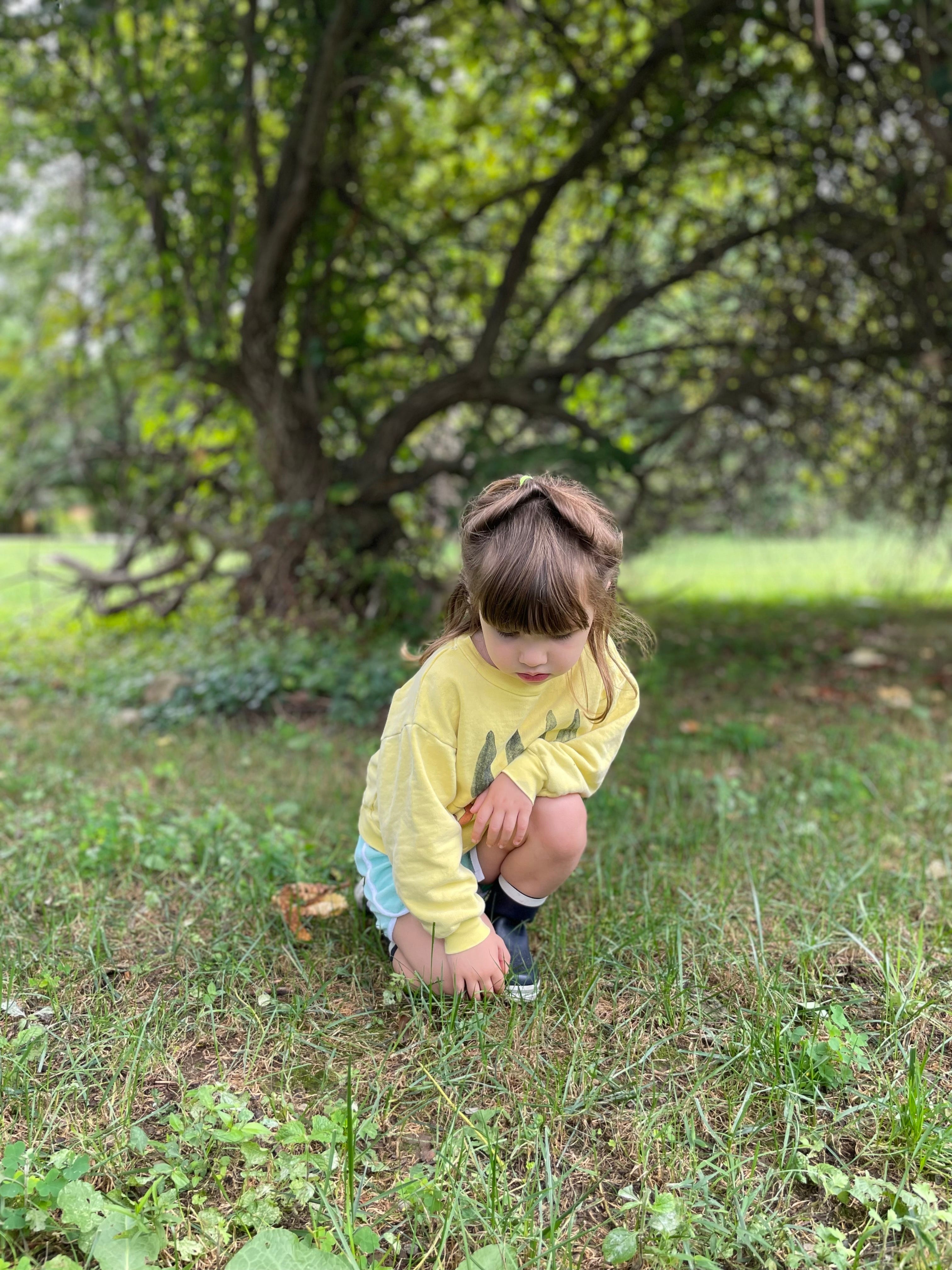
🪱 COMPOST FOR THE SOUL
We are not idealized wild things. We are imperfect mortal beings, aware of that mortality even as we push it away, failed by our very complication, so wired that when we mourn our losses we also mourn, for better or for worse, ourselves.
—Joan Didion, The Year of Magical Thinking
🐝 BEE STILL MY HEART
Spotted: a bumblebee sleeping in the crook of a Mexican sunflower, legs curled like punctuation. Bees don’t have eyelids, so they just… stop. Sometimes they grip the petal with one leg, sometimes they tumble backward into the pollen like they passed out at the world’s sweetest party. Seriously, is there anything cuter?

🐓 BACKYARD DISPATCH
All the Coop’s a Stage
This morning, a sound I’d never heard before rang out across the yard: a deep, vibrating oooooOoOMmmm that could only be described as Tibetan throat singing. It was so startling I was sure a monk had wandered into the garden again. But no—it was Feather Locklear, delivering his aria with all the gravitas of a Gregorian chant.
When I reached the run, everything seemed fine—until a quick headcount revealed only four chickens. Where was Yolko Ono?
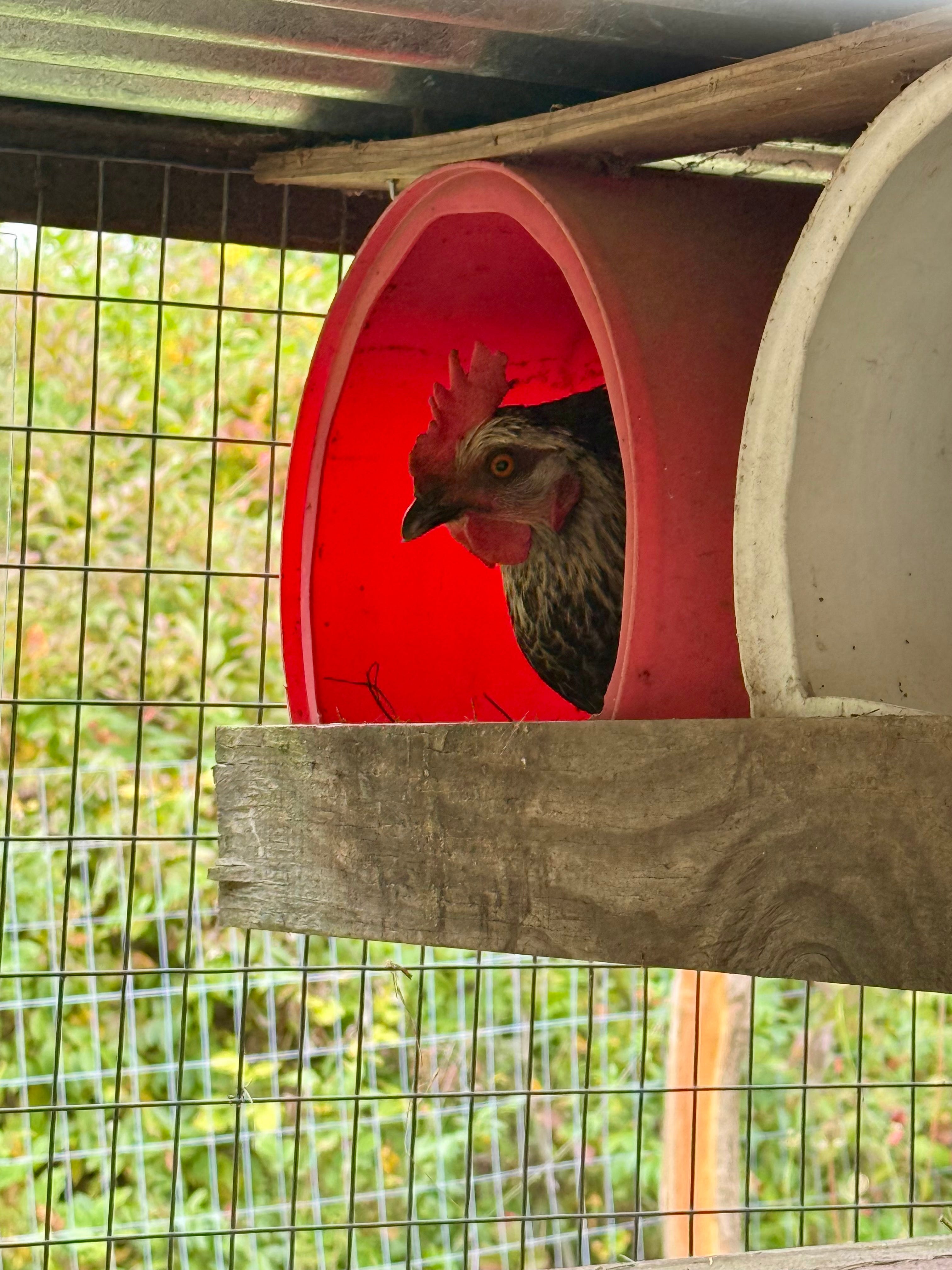
Turns out Yolko was holed up in one of the laying boxes, body flattened, eyes glassy—the unmistakable trance of broodiness. As soon as she spotted me, she burst out, clucking furiously and pacing tight circles inside the coop.
And then Feather began pacing too. Outside the coop, he matched her steps and mirrored her calls, clucking back like an expectant father in a 1950s waiting room. I even have a video where their voices overlap in perfect sync: call and response, anxiety harmonized. It was like stumbling into Act III of a chicken opera I didn’t want to watch.1
Which raises the central question: is Yolko actually brooding a fertilized egg—Feather’s legacy, the first true heir of this gothic dynasty? Or is she staging the performance of her life, a diversion to keep me from discovering whatever… other conspiracy is hatching in the coop?
Meanwhile, I’m left with a video and a mystery: by next week, will we have a chick, or just more drama?
🪰 GNAT’S ALL, FOLKS!
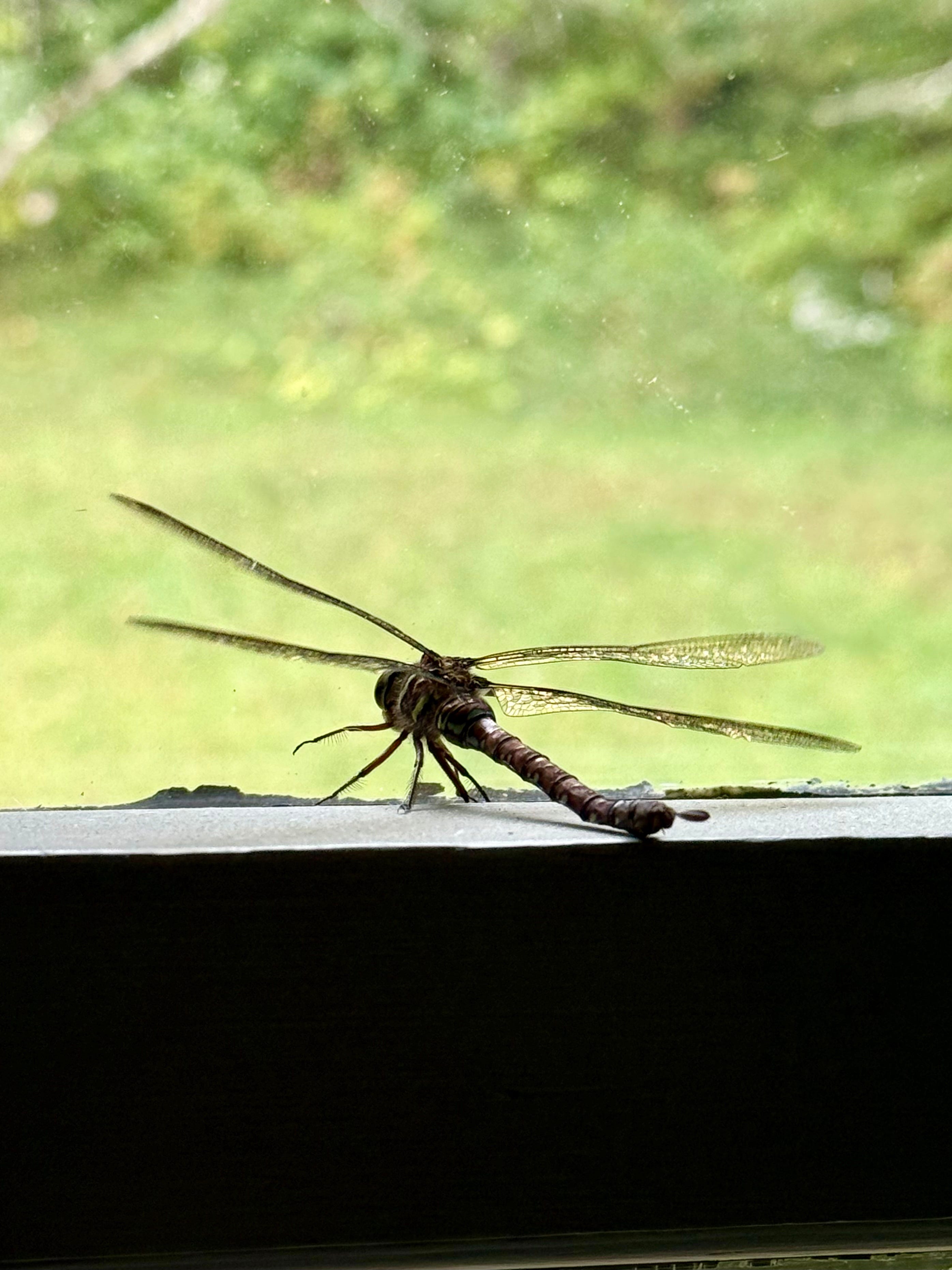
Ode to a Dragonfly in My Kitchen
You entered as if on purpose,
a shard of stained glass trembling in the air,
green-black wings catching the light.
But then—
confusion!
Every window became a trap,
every pane a promise you battered against,
a sky that refused to open.
I tried to shepherd you with a dishtowel,
a saint with no miracles,
while you clattered against the glass.
Dragonfly—
architect of summer ponds,
hunter of mosquitoes,
little chariot of iridescence—
you forgot yourself for a moment there.
Forgot that the way out
was not forward, but sideways.
When at last the door cracked open,
you threaded it like a prayer bead,
vanishing back to the garden’s buzzing choir.
And I, left in the stillness,
wondered how many times I’ve done the same—
mistaking walls for sky,
mistaking glass for possibility,
flinging myself toward something
that will never yield.
May we both learn:
sometimes the exit isn’t where the light is.
Sometimes freedom is a sideways door.
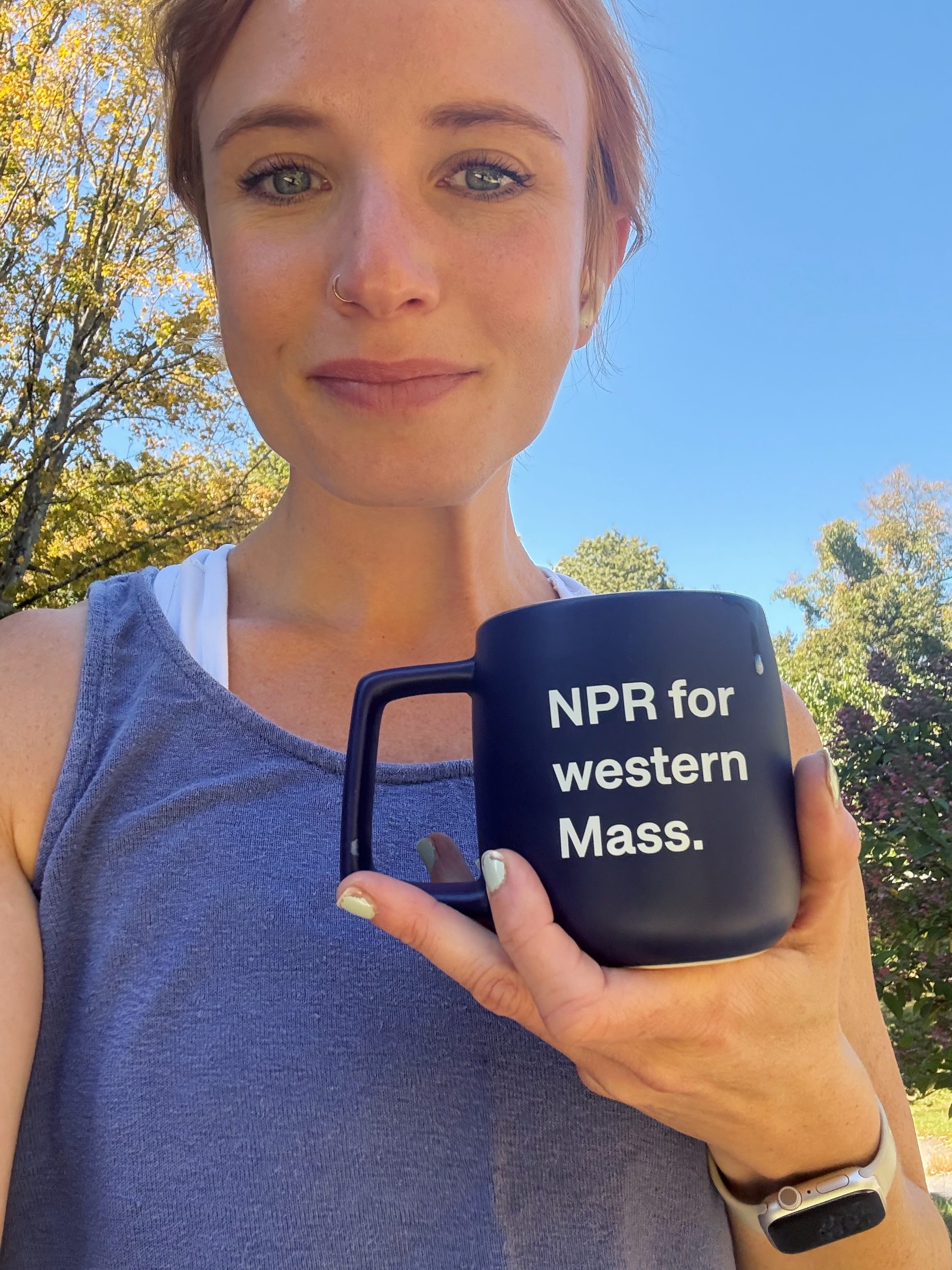
Stay dirty (and support your local NPR station),
x bex
As opposed to the chicken operas I do want to watch.
💫
Gorgeous, Bex